

Background
The project was started by a group of members whose design skills are quite different. However, we all have a same interest which is to build new interactive games with attractive graphics and character design.
We chose materials in Vietnamese history such as real heroes in combination with mythical creatures to build a game that provides player to experience in an unconventional way which is not screen and keyboard.


Stage A: Character Design
The team opted Dinh Bo Linh (the "Undefeated Reed Flag King") as our first game character. He is one of the notable heroes in the Vietnamese late dynastic epoch (939–1945), but he’s a little bit unrecognized in comparison with some later kings and generals, so we want people get to know more about his life and achievements.
We designed the young Dinh Bo Linh with simple costume and dynastic-period hairstyle, but with a small modern touch. We wanted to stay with animated style so that the game can friendly bring historical aspects to young children and teenagers, who are our main target audiences.
Also, our 2D character designer sketched the Nine-tusk Elephant, and then our 3D guys modelled it in a very cute style. Dinh Bo Linh also got a better retouch and looked more manly with enhanced amour.


Our second heroines were the Trung Sisters. Trung Trac and her younger sister Trung Nhi were eminent female military leaders in AD 40, and they are characterized by riding elephants on battlefield. After many sketches, we came with the final design having combative costumes, unlike the former designs with traditional Ao Tu Than.
"Colors choice: My inspiration for Trung Sisters
came from Vietnamese traditional festival flag. For Trung Trac, I chose red, yellow to show that she is the elder sister, mature and fearsome, and the green to highlight the cloth. Also, to implicate she was the leader - the first one to raise rebellion.
And since Trung Nhi is the little sister, I chose light pink and blue to create the feeling of being young, cute and a bit composure, and the teal is to highlight the cloth. The reason for the Trung Sisters identical cloth (beside colors) is to emphasize that they are sisters."
- Nguyen, Character Designer

Flags in a Vietnamese traditional festival
Image source: http://dangcongsan.vn/preview/newid/112601.html

Stage B: Modelling, Animation & Programming
This was the most intensive stage when we were applying many techniques with different tools and software such as Cinema 4D, 3ds Max, After Effects and Unity. The two most remarkable things were the application of Kinect and Arduino.


Nine-tusk Elephant Animation

"The most difficult part of this process is to implement the database from Visual Gesture Builder to Unity. This includes testing and adjusting the code many times."
- Anh, 3D Modeler & Programmer


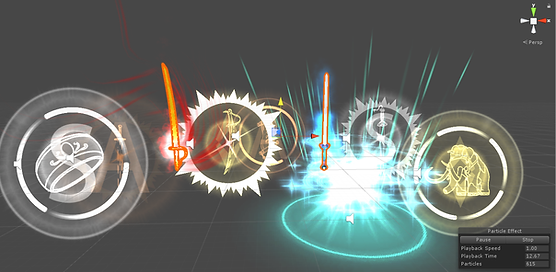


To understand more about the real gameplay, please continue reading the next stage below with a demo video.
Stage C: Gameplay Design & Display Setup
At first we got an idea using project mapping for a board game that would have an interface like the chess game and some RPG features like Dungeon & Dragons, but then we realized that it would be hard to approach as the players have to learn how to play. Thus, we decided to turn it to a turn-based fighting game, when we used Holograms as displays.


The overall system consists of 2 main separate units.
The first one is an interactive hologram with the elephant. We provided players interactions between the real world and digital world, when the elephant and characters would have reactions depending on player’s commands. This special interactive feature was implemented by help of a hardware device, which is Microsoft Kinect.
"The very first version of the Pyramid Hologram was made with thin Mica plastic and foam - the same material for the frame stand. I used super glue and hot glue to stick them."
- Kiet, Gameplay Designer


The second unit is like... "And then we moved on to the next step to create a new gameplay and more contents. We have changed our gameplay design many times to finally reach a final state. We made it into a Hologram Arcade Game."
- Kiet, Gameplay Desinger


The Great Tale Gameplay Demo
Gameplay Summary
-
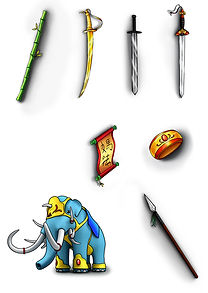
Step 1: Two players will Gacha for the weapon and they have 2 turns. If they don’t get weapons for their characters, they can trade with each other.
-
Step 2: Each player will select one side, pick up the character figure in the middle of the tray and scan through the pad. After that they can store their characters on the character slots of the tray.
-
Step 3: Then they select the weapons that they like and scan them through the pads again, so their characters will be equipped with those weapons. The characters will use those weapons for the fight (only Legendary Weapon will have character skill cut-in).
-
Step 4: After two players finish equipping their characters, the fight will begin. A deciding factor of the fight is the winning percentage of the weapons:
-
Legendary Weapon: 50% Winning Rate
-
Silver Weapon: 30% Winning Rate
-
Copper Weapon: 10% Winning Rate
-
The game will mainly based on your luck so… Best wishes for your victory!
